Choosing the right Half Surface Safety Hinge in 2026 requires more than comparing prices or polished product photographs. A hinge may look sturdy online, yet fail to suit a heavy door, narrow frame, or frequent-use entrance. The best choice depends on door weight, opening direction, frame material, clearance, and expected traffic.
Small details matter. A busy school door may need corrosion-resistant steel, concealed fasteners, and smooth self-closing movement. A healthcare entrance may require easy cleaning and dependable performance under constant use. Check the hinge’s rated load, cycle testing, mounting method, and compatibility with existing locks or access-control hardware. Manufacturer datasheets provide useful evidence, but independent installation guidance deserves equal attention.
A practical evaluation should include a physical fit check. Measure the frame, inspect screw locations, and confirm that the door does not bind at 90 or 180 degrees. It is easy to overlook hinge thickness. That mistake can create rubbing, noise, or uneven gaps. No hinge is perfect.
In 2026, buyers should also consider recyclable materials, replacement availability, warranty clarity, and long-term maintenance. Products supported by recognized testing information are generally easier to assess. However, certification markings alone do not guarantee a suitable installation. Local building requirements and door-system specifications still need professional review.
The most reliable decision combines manufacturer evidence, installer experience, and realistic site conditions. Choose performance first. Cost matters, but premature replacement costs more. A careful comparison can produce safer movement, cleaner alignment, and fewer maintenance surprises over the door’s working life.
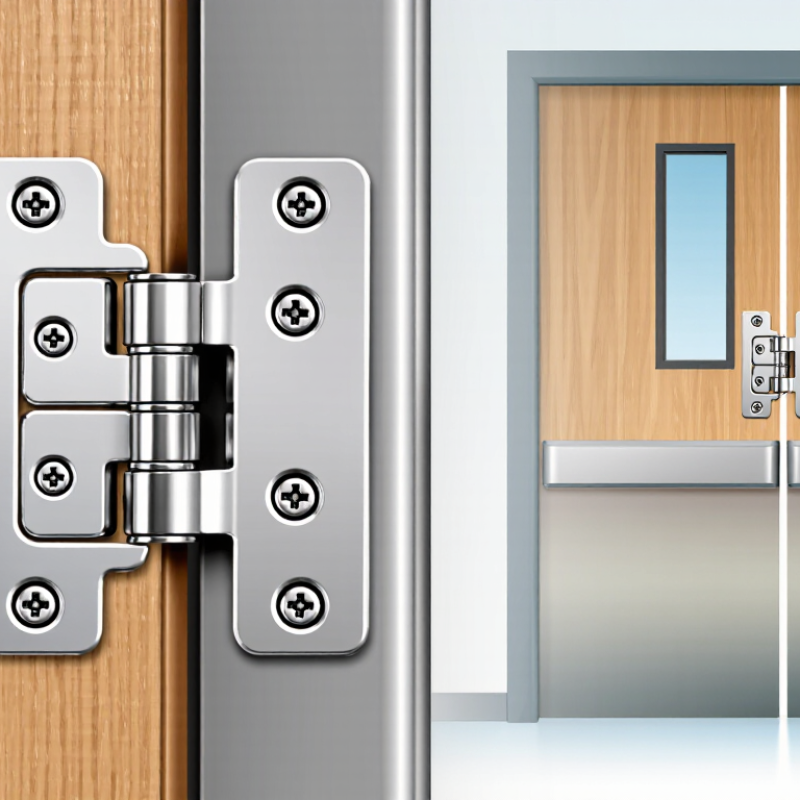
Half surface safety hinges mount visibly on the door and frame. They suit retrofit projects, steel doors, and narrow frame conditions. Their main function is simple: support the door while limiting unsafe access around the hinge side. Many models use non-removable pins, security screws, or continuous plates. These details can reduce tampering, but they do not replace correct installation.
The U.S. National Fire Protection Association reported about 1.5 million fires in 2023. That figure reinforces the need for reliable door movement and unobstructed exits. A suitable hinge must match the door’s weight, height, opening frequency, and surrounding clearance. Check its load rating under real conditions, not only the catalog rating. Temperature, moisture, and corrosive cleaning chemicals can also shorten service life.
Industry guidance, including ANSI/BHMA hinge standards, emphasizes cycle performance, dimensions, and material quality. Measure the door thickness first. Then verify screw length, pin design, and frame compatibility. Stainless steel often performs better in damp environments, while reinforced steel may suit heavy commercial doors. A common mistake is choosing the strongest hinge without checking alignment. Even a high-rated hinge can bind, sag, or damage the frame. Field experience is useful, but records of door weight and daily cycles are better evidence. No selection is perfect. Recheck the hardware after installation.
Choosing the best half surface safety hinge starts with the door and frame, not the hinge catalog. Measure door weight, thickness, width, swing direction, frame material, and available clearance. A steel security door may need stronger bearings than a lightweight interior door. Check whether the frame is reinforced enough for surface-mounted fasteners. Small alignment errors can create rubbing, sagging, or unsafe closing.
The security requirement deserves equal attention. A non-removable pin, tamper-resistant screws, and protected knuckles can reduce forced removal. However, these features do not replace a properly rated door assembly. NFPA’s Fire Loss in the United States report recorded 1,504,500 fires in the United States during 2023. For fire-rated openings, verify compatibility with the complete labeled assembly and applicable NFPA 80 requirements. ANSI/BHMA A156.1 also provides recognized hinge performance testing for load and durability. Ask for test documentation, not broad sales claims.
I often see buyers select hinges by door weight alone. That shortcut fails when traffic is heavy or the frame flexes. Estimate daily cycles, then inspect the hinge after installation. A simple paper clearance check can expose binding early. Do not ignore user safety, either. A hinge may protect against tampering while creating a pinch point. A measured mock-up is slower, but usually wiser. The rating table is not the whole story.
How to Choose the Best Half Surface Safety Hinge in 2026
Material choice should match the door environment, not just the purchase price. Stainless steel suits humid corridors, food areas, and outdoor access points. Zinc-plated steel can work indoors where moisture remains controlled. Brass offers a traditional appearance, but it may not suit heavy security doors. Check the hinge thickness, pin design, and corrosion test data before deciding. Appearance can mislead.
Load ratings need careful interpretation. A listed rating may describe one hinge under static laboratory conditions. Real doors add vibration, repeated slamming, uneven frames, and sideways loading. Calculate the complete door weight, including closers, glass, and attached hardware. Then allow a sensible safety margin. Three light-duty hinges may not outperform two properly rated heavy-duty hinges. Installation changes everything.
Useful features include non-removable pins, concealed fasteners, bearing support, and adjustable mounting holes. A half surface design should cover the frame and door edge without creating sharp projections. Measure clearances with the door fully open. A hinge that looks secure on a workbench may bind after installation. That detail is easy to miss. Review the fixing material and substrate strength, too. A strong hinge cannot compensate for weak screws or a damaged frame. Recheck alignment after several opening cycles, because small movement can become a serious maintenance problem.
Comparing common hinge materials by typical ultimate tensile strength. These material benchmarks help with initial selection, but the actual hinge load rating depends on hinge geometry, screw pattern, door weight, installation quality, and the manufacturer’s tested specifications.
Selection guide: Carbon steel generally offers high strength at a low cost, stainless steel provides strong corrosion resistance for demanding environments, aluminum reduces weight but has lower strength, and brass is commonly selected where appearance and corrosion resistance are important. Always verify the tested load rating and safety factor for the specific half surface safety hinge.
How to Choose the Best Half Surface Safety Hinge in 2026
Installation method should match the door, frame, and expected traffic. A half surface hinge can simplify retrofit work because one leaf mounts on the frame surface. However, inaccurate marking may create uneven gaps, rubbing, or weak screw engagement. Measure door thickness, hinge height, frame material, swing direction, and clearance before drilling. Through-fasteners usually provide stronger support than short wood screws on busy doors. Still, over-tightening can distort the frame.
Compatibility involves more than dimensions. Check the hinge’s load rating against the complete door assembly, including closers and protective plates. For accessible interior doors, the U.S. Access Board’s ADA Standards limit opening force to 5 pounds for many non-fire doors. The hinge should support smooth movement without increasing that force. The 2023 Bureau of Labor Statistics report recorded about 2.6 million nonfatal private-industry injuries and illnesses in 2023. That figure is not hinge-specific, but it supports careful attention to pinch points and closing speed.
Maintenance is often underestimated. NFPA 80 requires documented annual inspection for fire door assemblies, where applicable. Inspect loose screws, metal fatigue, corrosion, binding, and damaged fastener holes. Clean debris from the knuckle and use only approved lubricant. Test the door under normal load. Small errors matter. I would also recheck alignment after the first month, because new installations can settle. That extra visit is easy to skip.
| Evaluation Criterion | Screw-On Installation | Weld-On Installation | Through-Bolt Installation | Recommended Selection Guidance |
|---|---|---|---|---|
| Typical installation time | 15–30 minutes per hinge | 30–60 minutes per hinge, including surface preparation | 25–45 minutes per hinge | Choose screw-on designs for routine replacement and field installation. |
| Suitable door materials | Steel, aluminum, wood, and reinforced composite doors | Steel doors and steel frames only, unless approved welding procedures are available | Steel, aluminum, wood, and composite doors with accessible rear clearance | Verify the door and frame can support the selected fastener system without deformation. |
| Adjustability after installation | High; screws can usually be retightened or repositioned within the allowed range | Low; adjustment generally requires grinding, cutting, or rewelding | Medium to high; alignment can be corrected before final tightening | Prioritize adjustable mounting holes where door sag or frequent alignment changes are expected. |
| Security resistance | Good when security screws, concealed fasteners, or reinforced substrates are used | Very high when the weld is continuous and properly inspected | High when tamper-resistant nuts, bolts, and internal backing plates are used | Match the hinge method to the site threat level and the strength of the surrounding structure. |
| Removal and replacement | Easy to moderate, depending on fastener type | Difficult; requires cutting and refinishing | Moderate; requires access to the rear side of the mounting surface | Use screw-on or through-bolt mounting where future service access is important. |
| Required tools | Drill, bits, driver, level, measuring tools, and thread-locking compound where specified | Welder, clamps, grinding equipment, protective equipment, and coating materials | Drill, through-bits, wrench set, clamps, and alignment tools | Select a method that matches the available tools and the installer’s qualifications. |
| Load and door-size considerations | Commonly used for light- to medium-duty doors when fastener spacing and substrate strength are adequate | Suitable for heavy steel doors when the frame and weld design are engineered for the load | Suitable for medium- to heavy-duty doors with a reinforced mounting area | Check the manufacturer’s load rating; do not size a hinge by door weight alone. |
| Compatibility checks | Confirm hinge height, leaf thickness, screw diameter, hole spacing, and door swing | Confirm steel grade, weldable surfaces, clearances, and coating requirements | Confirm bolt length, rear clearance, backing-plate size, hole diameter, and swing direction | Measure the existing hinge pattern before ordering a replacement. |
| Recommended clearance | Maintain the door manufacturer’s specified reveal; many metal-door systems use approximately 3 mm at the sides and top | Set the reveal before welding and protect the gap from weld distortion | Use shims or temporary spacers during alignment to prevent binding | Use the door and frame specification rather than assuming one universal clearance. |
| Routine maintenance interval | Inspect every 6–12 months; increase frequency in high-traffic or outdoor locations | Inspect every 6–12 months for weld cracks, corrosion, and coating damage | Inspect every 6–12 months for loose hardware, wear, and corrosion | Set the interval according to traffic, weather exposure, and security requirements. |
| Lubrication requirement | Apply a compatible hinge lubricant when movement becomes noisy or stiff; avoid attracting abrasive dust | Lubricate the bearing or pin only if the hinge design permits it | Lubricate serviceable pivot points according to the hinge instructions | Do not lubricate sealed or self-lubricating components unless permitted. |
| Corrosion protection | Use a finish suitable for the environment; seal drilled holes and damaged coating | Remove weld scale, prime exposed steel, and restore the protective coating | Protect cut edges, bolt holes, and dissimilar-metal contact areas | For exterior or humid locations, verify the finish and fasteners are corrosion-compatible. |
| Common warning signs | Loose screws, elongated holes, door sag, binding, or damaged security heads | Cracked welds, rust lines, distortion, unusual noise, or a growing door reveal | Loose nuts, shifting leaves, cracked backing material, or uneven pivot wear | Repair the cause of movement before simply tightening or replacing hardware. |
Selecting the Best Half Surface Safety Hinge for 2026 Needs
Choosing a half surface safety hinge starts with the door, not the catalogue. Measure door weight, thickness, frame material, and opening frequency. A busy corridor may create thousands of cycles yearly. Select a hinge with tested load capacity above the actual door weight. That small margin matters.
NFPA’s Fire Loss in the United States During 2023 report estimated 1,388,500 fires and about $22 billion in property damage. This does not make every hinge fire-rated. However, it shows why door hardware deserves careful review. For rated openings, confirm compatibility with the complete door assembly and applicable NFPA 80 requirements. ANSI/BHMA A156.1 also provides a useful benchmark for hinge performance and testing.
Look for a non-removable pin, smooth knuckle movement, and fasteners suited to the frame. Stainless steel can help in humid areas, but material alone does not guarantee long service. Check corrosion testing, cycle data, and installation instructions. A hinge that feels strong in the hand may still sag after repeated use. I have found that alignment errors often cause premature wear, not weak metal. That point is easy to overlook. Review clearances, screw engagement, and maintenance access before ordering. Safety needs evidence, not attractive specifications.
It mounts visibly on the door and frame. It supports movement and limits access near the hinge side.
It suits steel doors, retrofit projects, and narrow frames. Visible mounting can simplify installation where concealed hardware will not fit.
Include the door, glass, closer, and attached hardware. Consider slamming, vibration, daily cycles, and sideways loading.
Not always. Laboratory ratings may not reflect moisture, uneven frames, or repeated impacts in actual use.
Stainless steel usually performs well in humid corridors, food areas, and outdoor access points. Check corrosion data before purchasing.
Look for non-removable pins, security screws, continuous plates, and strong bearing support. Features vary.
Measure door thickness, frame width, clearances, screw length, and the fully open position. Measure twice.
No. A high-rated hinge can still bind, sag, or damage the frame when alignment is poor.
Use suitable screws and a sound frame. Recheck alignment after several opening cycles, especially when the door begins dragging.
Choosing the best Half Surface Safety Hinge in 2026 begins with understanding how it supports both door movement and security. This hinge style is designed to improve resistance against forced removal while allowing practical access and smooth operation. Start by assessing the door’s weight, thickness, usage frequency, frame structure, and required security level. These factors will help determine the appropriate hinge size, configuration, and load rating.
Next, compare materials such as stainless steel or reinforced alloys, considering durability, corrosion resistance, and indoor or outdoor conditions. Review features including non-removable pins, bearing support, alignment options, and adjustable mounting designs. Installation should match the existing door and frame, with accurate measurements and suitable fasteners to ensure reliable performance. Regular inspection, tightening, cleaning, and lubrication can extend service life. By balancing security, compatibility, strength, maintenance needs, and installation requirements, you can select a Half Surface Safety Hinge that delivers dependable long-term performance for modern residential, commercial, or institutional applications.
LvXing Hinges